





HPE Morpheus VM Essentials: The Sweet Spot of Virtualization
 Szabolcs Szilágyi
 2026.04.16

Everything you really need, with customer-friendly licensing and HPE support—EURO ONE supports you throughout the entire lifecycle of your virtualization projects.
HPE provides a management and automation interface based on advanced, easy-to-learn logic for the widely used KVM virtualization technology. The compact platform offers simple and well-supported operability, and thanks to its socket-based licensing, its use on modern, multi-core servers delivers significant cost savings.
HPE provides a management and automation interface based on advanced, easy-to-learn logic for the widely used KVM virtualization technology. The compact platform offers simple and well-supported operability, and thanks to its socket-based licensing, its use on modern, multi-core servers delivers significant cost savings.
All of this can be quantified using the HPE CloudPhysics platform; entire virtualization environments can even be analyzed as needed. The system is capable of assessing resource utilization, energy consumption, licensing costs, and consolidation opportunities within the existing infrastructure. Based on the results, it is possible to model the cost differences between various virtualization platforms over a 3- to 5-year period.
In the current market environment, this is a particularly important consideration. The explosive demand for artificial intelligence solutions is placing significant pressure on data center infrastructures and the component market, which is reflected in rising prices for memory, SSDs, and, in many cases, CPUs. In this environment, a key question for many organizations is how to utilize existing infrastructure and resources more efficiently, and one way to do this is by avoiding excessive licensing costs.
Why isn’t a free virtualization platform enough?
When exploring alternatives, the question inevitably arises: should we use an open-source solution? While this may indeed offer a cost-effective option for smaller environments, enterprise-level infrastructures often lack the qualifications, features, and integrations necessary for reliable operation. HPE VM Essentials, on the other hand, offers a number of capabilities that enterprises have come to expect, such as cluster management, shared storage, advanced datastore management, and integrated virtualization management capabilities.
The platform supports migration with built-in tools and also allows for the parallel management of both environments from the same management interface. This can significantly reduce the risks associated with the transition and paves the way for a less disruptive, phased migration.
One of the strengths of the HPE Morpheus platform is that it functions not only as a virtualization layer but also supports infrastructure automation. The system can manage container platforms through the same interface and, if necessary, assist in setting up such environments. Through the self-service infrastructure portal, development or business teams can request resources on their own. This can significantly accelerate the delivery of IT services, while the IT department retains control over the resources.
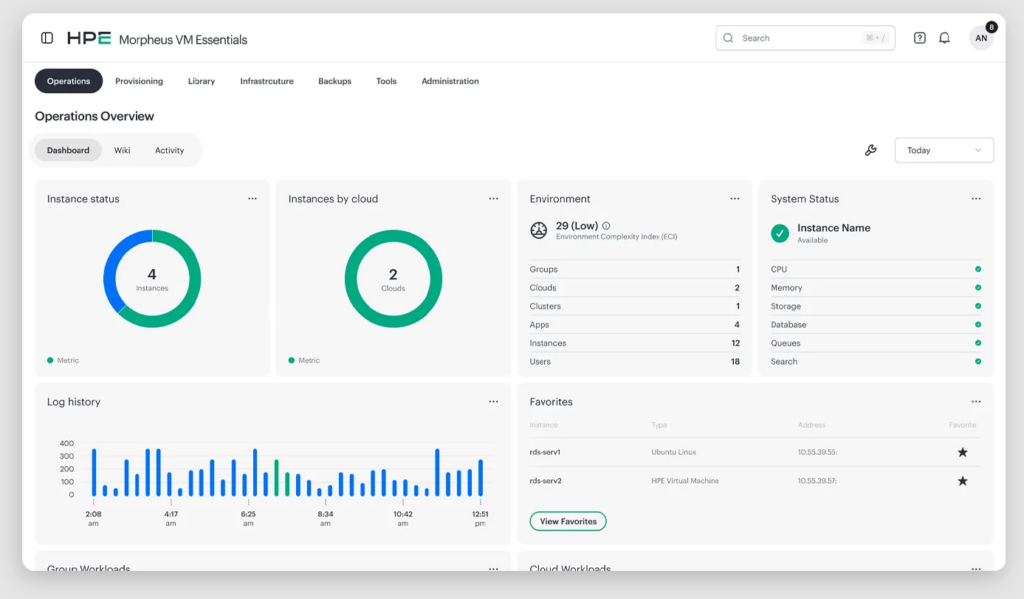
With HPE Morpheus, costs become transparent and thus easier to manage. The management interface allows you to configure the costs of individual infrastructure resources, enabling you to accurately track resource usage for a specific virtual environment or project. This is particularly important for large organizations where infrastructure expenses need to be allocated across departments or projects.
Integration with the entire HPE ecosystem
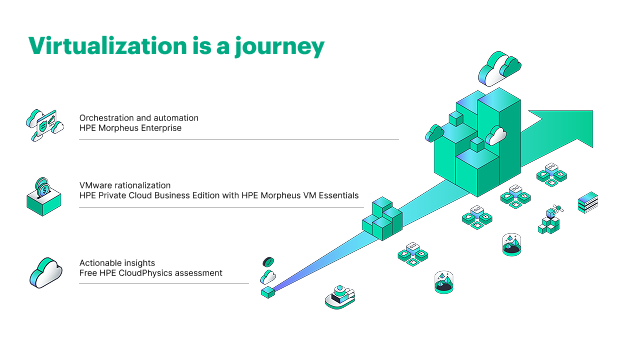
One key advantage of HPE VM Essentials is that it integrates seamlessly with HPE’s infrastructure portfolio. This enables, for example, the implementation of network micro segmentation using HPE Aruba networking devices, as well as the integration of HPE storage systems. Support for hardware and software components from a single source ensures simpler operation and faster troubleshooting. The platform also serves as an entry point to HPE Morpheus, a comprehensive automation and orchestration solution that is also suitable for managing multi-cloud infrastructures.
The success of technology implementation depends on proper planning and a phased transition, for which it is advisable to involve an external expert partner from the very beginning. Our specialists have decades of experience in HPE system integration and have already conducted demonstrations and pilot projects with the HPE VM Essentials platform for numerous clients. Starting from the assessment and planning phases, through the transition, to supporting the live system and performing necessary fine-tuning, they assist their clients throughout the entire lifecycle—including break-and-fix services as a certified HPE service partner—in the development and operation of cost-effective virtualization. Integration with existing systems—such as backup, archiving, and monitoring platforms—ensures a perfect fit for the specific needs of each organization.
With the expiration of the last three-year lifecycle preceding market-transforming licensing changes, the majority of IT leaders are being forced to make decisions. The coming year will therefore be a critical period for users of virtualized platforms, but they do not have to face this alone. We offer them essential support in technology, experience, and up-to-date knowledge, along with measurable cost-optimization opportunities and the development of a long-term, sustainable virtualization architecture built on the HPE Morpheus VM Essentials platform.