




Cisco’s quantum switch points beyond standalone computers
 Gusztáv Krékity
 2026.05.07

For years, quantum technology has mostly been discussed through bigger, faster, and more stable quantum computers. Cisco’s latest announcement shifts attention to a quieter but strategically important question: how can different quantum systems be connected so they can work together?
Instead of presenting another powerful quantum computer, Cisco is targeting the infrastructure layer. Its Universal Quantum Switch is designed to help quantum systems using different technologies communicate with each other — a challenge that could become essential as quantum computing moves beyond isolated machines.
A new link for quantum systems
Cisco’s Universal Quantum Switch is a research prototype focused on one of the core barriers to quantum networking: interoperability.
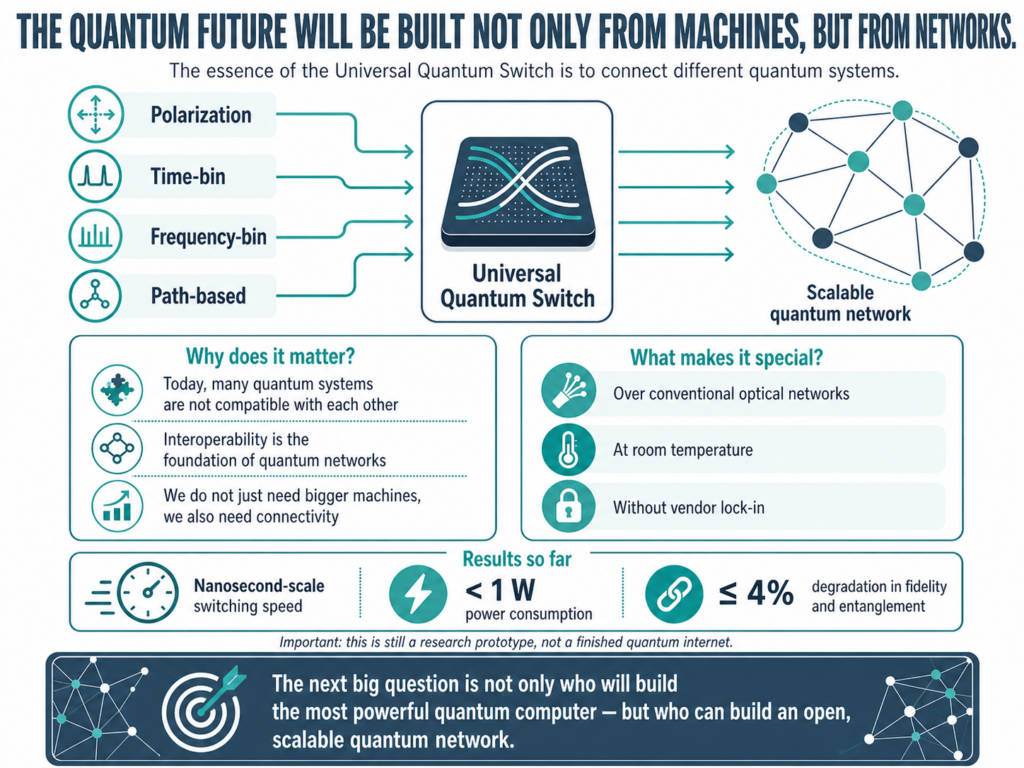
Quantum systems can encode information in several ways, including polarization, time-bin, frequency-bin, and path-based encoding. Because of this, systems built on different technologies are often not directly compatible.
Cisco’s concept aims to convert between these encoding modes without destroying the quantum information. That makes the switch less about increasing the power of a single quantum computer and more about helping different systems become part of a broader network.
Why interoperability matters
Interoperability may sound less spectacular than a new performance record, but the history of the classical internet shows that real breakthroughs often come from connecting systems into scalable networks.
Quantum technology now faces a similar challenge. Future applications in healthcare, financial services, and industrial research may require capacities beyond what one standalone system can provide. Distributed and interconnected quantum systems could therefore become a logical next step.
The future of quantum computing may depend not only on powerful machines, but on an open, scalable, and interoperable ecosystem around them.
What makes Cisco’s approach notable
One of the key promises of the Universal Quantum Switch is that it is not designed around a single vendor or technology ecosystem. The goal is to enable communication between different quantum systems, encoding methods, and vendor solutions.
Cisco highlights several practical advantages:
- it is designed for conventional optical networks
- it operates at room temperature
- it avoids vendor lock-in
These details matter because many quantum technologies require extreme operating conditions, such as cryogenic cooling. A solution that works on existing optical infrastructure and at room temperature could be closer to practical deployment.
What the prototype has shown
Cisco says its experiments have already validated the switch with polarization coding. Support for time-bin and frequency-bin coding is part of the design and expected in the next validation steps.
According to the company’s measurements, the prototype:
- achieved switching speeds in the nanosecond range
- consumed less than 1 watt of power
- showed no more than 4 percent average degradation in quantum state
These are promising results, but the technology is still a research prototype, not a ready-to-deploy quantum internet solution.
From hype to infrastructure
Cisco’s Universal Quantum Switch points to a broader shift in quantum technology: from isolated hardware achievements toward connected systems.
If this direction works, the next phase of competition may not be only about who builds the most powerful standalone quantum computer. It may be about who can create a scalable, open, and vendor-neutral quantum networking platform.
The quantum future may therefore take shape not in isolated machines, but in networks — and this could be where earlier promises begin turning into real infrastructure.
Read the full article on our International subsidiary’s website by clicking on the logo: