




When the network is intelligent from the start
 Gusztáv Krékity
 2026.05.15

For years, corporate networks developed according to a familiar model: a stable infrastructure was built first, and new functions were added to it over time. Today, however, networks are expected to do more than simply operate reliably—they must also be intelligent.
Many manufacturers have responded by adding artificial intelligence capabilities to existing systems. While this can help, it also has clear limitations. The real shift comes with AI-native networks, where intelligence is not an extra layer, but part of the network’s basic design.
The problem: AI as an add-on
In traditional network environments, AI usually works as a supporting function. It collects data, analyzes events, prepares reports, and may provide recommendations. However, the underlying architecture often remains complex and still requires significant manual intervention.
This approach is becoming harder to maintain. Hybrid work, cloud-based applications, and the growing number of connected devices have made network environments more dynamic than ever. In this context, intelligence that reacts only after problems appear is no longer enough.
The key question is no longer whether a network uses AI, but whether it was built on AI from the beginning.
From traditional networks to AI-native architecture
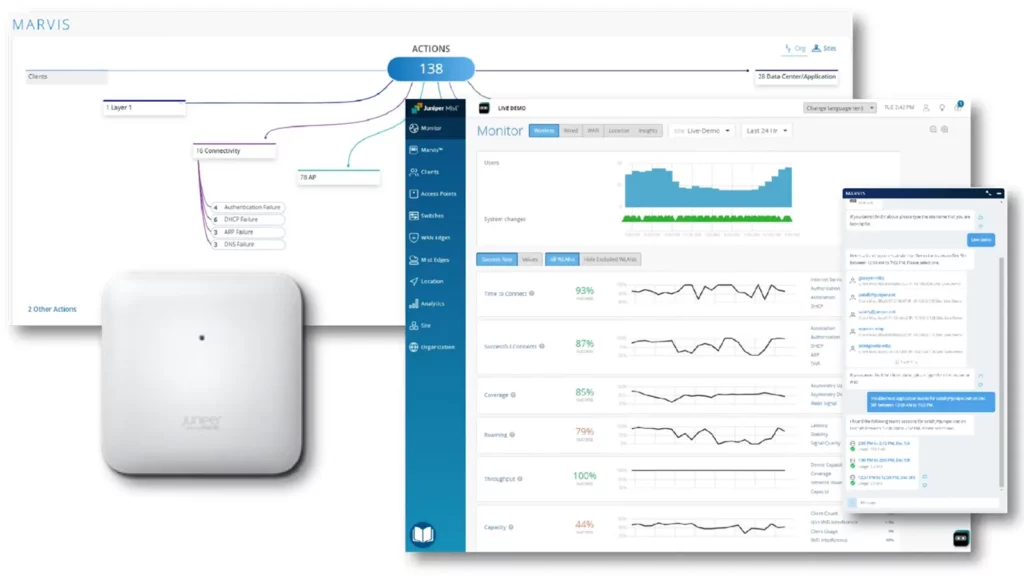
Juniper Mist AI represents this new approach. It is not a separate module added to the network, but a platform where AI is embedded across operations.
In practice, this means that the network:
- continuously adapts based on operational data
- understands events in context
- responds automatically to changes
This is supported by a cloud-native architecture designed for scalability and real-time operation. Intelligence is therefore not an optional feature, but the network’s natural operating state.
When the network operates on its own
One of the main benefits of an AI-native network is smoother operation. The system continuously monitors performance and user experience, then adjusts automatically where needed.
If an application slows down, the network does not only detect the issue. It evaluates the situation, identifies possible causes, and can take corrective action. This is especially valuable in environments where digital experience directly affects business performance.
Troubleshooting also becomes faster and more predictable. Instead of lengthy manual analysis, the system can identify cause-and-effect relationships and help IT teams resolve issues more efficiently.
Greater efficiency and control for the business
For business leaders, AI-native networking mainly means simplification. Fewer incidents, automated processes, and faster deployment can all contribute to lower operational costs.
At the same time, the network becomes more transparent and easier to manage. This is particularly important in large enterprise environments, where reliability, control, and predictability are essential.
A stable digital experience also creates business value. Whether users are employees or customers, reliable services improve satisfaction and support long-term loyalty.
From network infrastructure to business platform
Hewlett Packard Enterprise adds another important dimension to this model. With its edge-to-cloud approach and service-based solutions such as GreenLake, the network can become part of a broader, flexible infrastructure platform.
Combined with Juniper Networks’ AI-native capabilities, this creates an operating model where infrastructure does not slow down innovation, but actively supports it.
AI in networking is therefore not just another technological improvement. It represents a change in how networks are designed, operated, and connected to business goals.
Turning AI-native networking into business value
The value of AI-native networks becomes clear when technology is translated into a practical, business-focused operating model. The right platform is important, but successful implementation also requires an expert partner who understands enterprise infrastructure, the HPE–Juniper ecosystem, and the realities of integration and operation.
At EURO ONE, we support clients throughout this process. Our vendor knowledge, engineering expertise, and project experience help turn AI-native networking from a strategic concept into a working infrastructure that delivers measurable business value.
We assist with planning, implementation, integration, and long-term operation—so the network can become a simpler, more transparent, automated, and future-proof foundation for business.
Read the full article on our International subsidiary’s website by clicking on the logo: