



Generative AI vs. Agentic AI: two AI disciplines, one business goal
 Ivett Dobay
 2026.01.16
In enterprise conversations, artificial intelligence is often discussed as a single, unified capability. In reality, AI plays very different roles depending on how it is designed and applied. Two of the most influential AI disciplines shaping modern IT and cybersecurity today are generative AI and agentic AI.
While they serve distinct purposes, their true value emerges when they work together.
Understanding vs. acting: a simple analogy
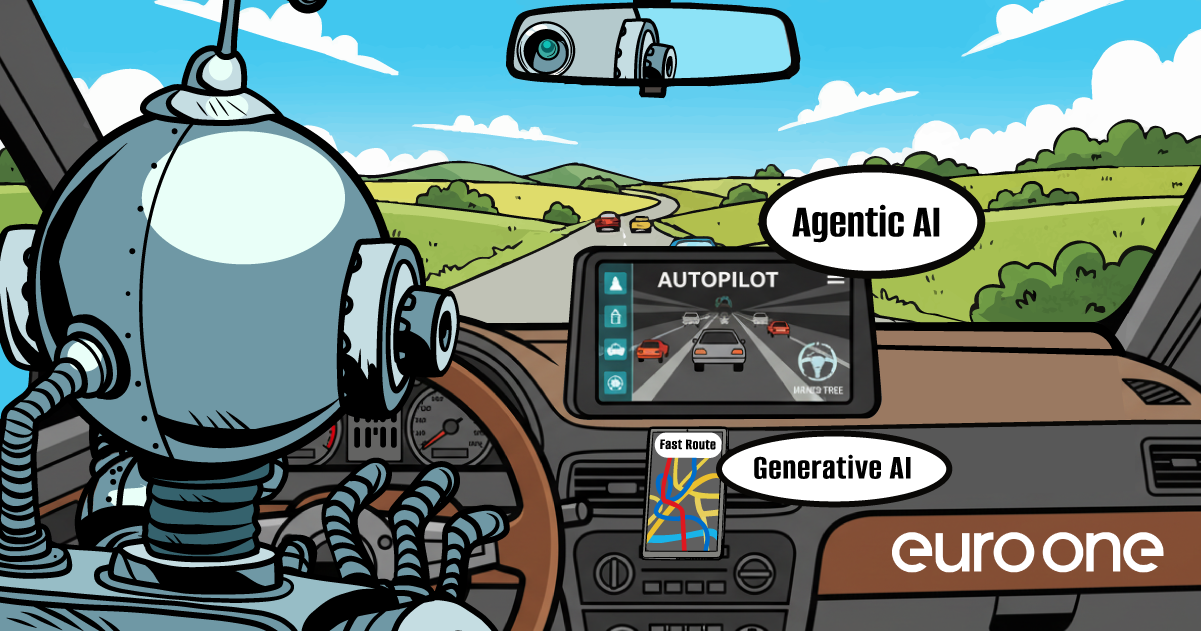
A useful way to understand the difference is to imagine a car.
Generative AI functions like a navigation system. It interprets data, summarizes what is happening, highlights options, and supports decision-making. It helps teams understand complex situations—but it does not take control.
Agentic AI, on the other hand, resembles a self-driving function. It not only analyzes events but also supports goal-driven action. It identifies patterns, connects signals, and helps move processes forward in real time—while remaining under human oversight.
This distinction between insight and action is critical in enterprise IT and security operations.
Where generative AI delivers value: IT operations and monitoring
In IT operations, the primary challenge is not a lack of data, but a lack of clarity. Modern environments generate massive volumes of metrics, logs, and alerts—often overwhelming operations teams.
Generative AI helps by:
- interpreting monitoring data across systems,
- summarizing incidents in both technical and business language,
- supporting prioritization and faster decision-making.
In this role, generative AI increases transparency and reduces uncertainty, enabling teams to respond more confidently and efficiently.
Where agentic AI makes the difference: cybersecurity and the SOC
In cybersecurity—especially within a Security Operations Center (SOC)—speed and consistency are essential. Security teams must correlate alerts, recognize attack patterns, and respond quickly to incidents.
Agentic AI supports this by:
- continuously monitoring security events,
- identifying relationships between isolated alerts,
- recognizing attack chains and escalation paths,
- preparing structured input for incident response decisions.
Rather than replacing human experts, agentic AI operates with controlled autonomy, reducing analyst workload and enabling faster, more consistent responses.
The real value lies in combination
From a business perspective, the greatest impact does not come from generative or agentic AI alone, but from their coordinated use.
- Generative AI provides context, transparency, and understanding.
- Agentic AI delivers speed, focus, and execution.
EURO ONE’s solutions put these two trends into practice, for example, on the operational side, generative AI helps make better decisions, while in SOC, agentic AI supports fast and efficient incident management.
Read the full article to explore how these AI disciplines work together in practice, including detailed enterprise use cases in IT operations and SOC environments: