





Organizational capability from AI tools — how to maximize the value of AI implementation
 Expert of Development division
 2026.08.05

In the wake of the spectacular development and growing prevalence of artificial intelligence, an increasing number of organizations are providing their employees with access to various AI tools.
In many cases, we see that supporting certain processes with AI tools can open up entirely new possibilities in terms of work efficiency and speed. Colleagues who previously struggled with language barriers can now confidently handle inquiries from abroad and quickly prepare summaries, presentations, or technical documents.
At the same time, employees do not respond to the new tools at the same pace or with the same receptiveness. While some are able to quickly integrate their use into their daily workflows, others may find it difficult to master the new methods, especially without adequate central support.
From individual practices to organizational value
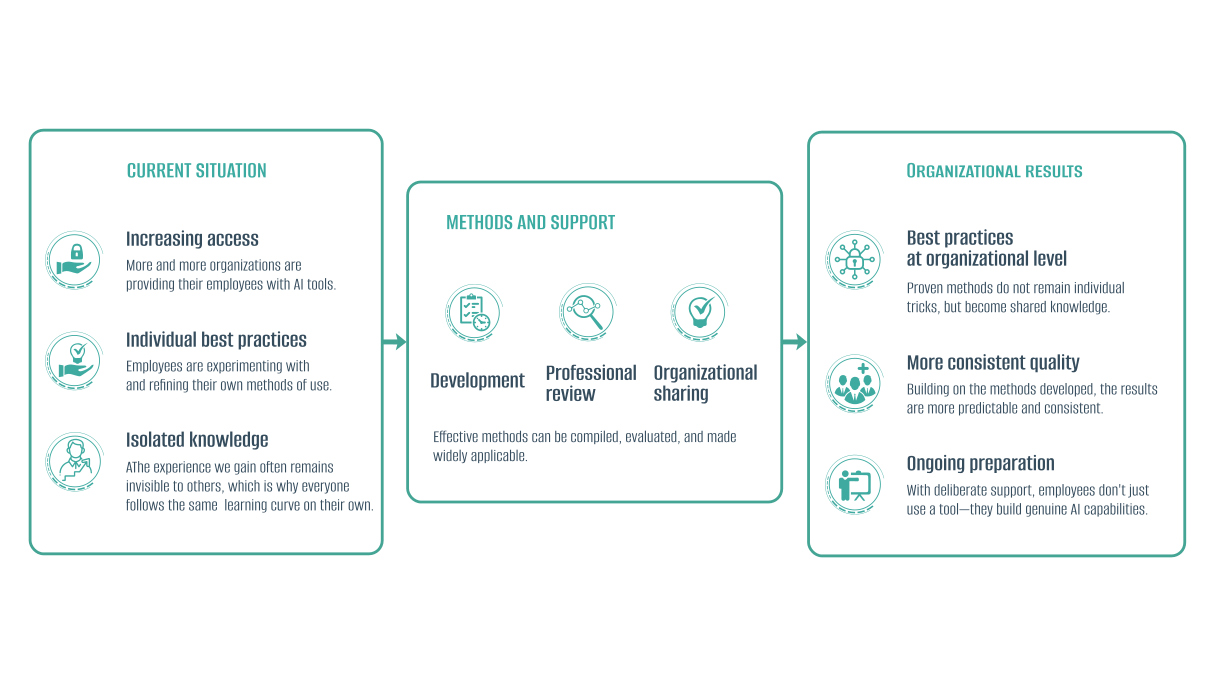
Alongside the widespread use of AI tools, well-established best practices—experimented with by individual employees—are emerging in numerous areas.
But what happens to the knowledge generated while optimizing individual workflows? Today, in most cases, this knowledge is not integrated into organizations’ day-to-day processes but remains in employees’ personal accounts—that is, it is owned not by the organization but exclusively by the employee who developed it. Yet this is a resource that is difficult to replace: experiential knowledge that lies not in the technology itself but in its effective use. Meanwhile, colleagues working on similar or even identical tasks cannot see or adopt the best practices that have been developed; instead, they are forced to go through the same learning curve over and over again, one by one. And when the employee who developed the method leaves, the accumulated knowledge typically leaves the organization with them.
All of this contributes to the contradictory situation we are encountering more and more often: subscriptions and tools are available, employees want to use them to work better and faster, yet the expected increase in efficiency fails to materialize. In such cases, decision-makers often conclude that the implementation of AI simply did not live up to expectations. Yet, with the right support, it would be possible not only for employees to use the available AI tools on their own initiative but also to build AI capabilities that extend across the entire organization. This requires background processes through which methods tested by employees can be submitted, evaluated from a professional standpoint, and, if proven effective, made available to the entire organization.
A standardized approach for consistent quality
It is a common experience among managers that, even though employees have access to the same tools, the quality of their work still varies significantly.
This is because the way a given task is formulated directly influences the quality of the output generated by language models. Through pre-developed, professionally vetted, template-based methods, quality can be standardized to a large extent and made independent of individual employees’ levels of proficiency.
This offers a twofold advantage: employees who are slower to master the use of new tools can rely on tangible, tried-and-true methods, while the organization can expect more consistent and higher-quality results.
Without preparedness, there is no control
Language models can sometimes generate content that is convincingly phrased yet inaccurate or one-sided; this is a well-known characteristic of the technology. However, the risk lies not in this alone, but in the human reaction to the content: a confidently worded response appears credible, and the user is inclined to accept it without verifying it. This phenomenon is referred to in the literature as automation bias.
Recognizing and managing this requires preparedness and the right mindset. Without established verification practices and experience, inaccurate content can find its way into analyses, recommendations, and executive summaries just as easily as accurate content.
Organizational support for AI use must therefore also include ongoing training for employees, as without conscious user behavior, the results of AI implementation may fall short of expectations.
How a tool becomes a capability
Elevating yoga practices to the organizational level, establishing more consistent quality based on well-developed methods, and continuously training employees together provide the framework within which AI tools can be transformed into genuine organizational value.
Throughout the summer, we’ll continue to present the approach that offers a transparent and consistent foundation for all of this. Be sure to follow us.